People often say that when dementia takes hold, it steals the person you once knew.
But they’re wrong.
It doesn’t erase a person. It simply rearranges the way they show up in the world. And if you look closely — with love, with patience — you can still see them. Sometimes in flashes. Sometimes in habits. And sometimes in the way they reach for your hand like it’s the only thing tethering them to the ground.
That’s how I still see him. Because I knew him — and I still do.
He’s always been the kind of man who speaks in actions more than words. A man who once said, “I’m off to build a castle for my wife,” and meant it — because that’s how he saw our home: something regal, something sacred, something worth building with his own two hands.
He is cheeky, irreverent, and full of dry humour that could turn a heated moment into a shared laugh. I still remember, before his diagnosis, when he was teaching me to drive. I was frustrated and snapped, “I’m not your staff to be told off!” Without missing a beat, he replied, “You’re right. If you were, I would’ve fired you yesterday.”
That was him. Witty. Quick. Never unkind.
Or how, after an argument, he’d disarm me completely by saying, “It’s so unfair of you to look that beautiful. Makes it impossible for me to stay mad.”
He never needed a stage to perform love — just a moment.
One Christmas, I was saving up to buy him a big TV. He found out and swung the car toward the shop, insisting, “Use our money. Just buy it now.”
That was him. Generous, always a step ahead, always cutting through sentiment with simple certainty: If something made me happy, it was worth having.
He proposed without preamble — took me to look at rings, told me to pick the best one, and just like that… we were engaged. No show. No fuss. Just knowing.
And when I once mentioned I was out test-driving a car, he rang me later that afternoon and said, “What colour do you want?” He had already called the dealership, already decided. Not because I needed a car — but because he wanted me to have something good.
That’s the man he’s always been.
He loved surprising me. But he could be surprised, too.
Like on his 65th birthday — I told him I had a work meeting in the hills and asked him to drive me. What he didn’t know was that I had already packed a bag with his clothes. He nearly caught me when he started searching for a pair of shoes I had already tucked away.
When we arrived, I handed him a note: You’ve been abducted for your birthday. He just smiled and said, “But I don’t have a change of clothes!” Then he looked at me and laughed: “I’ll never believe you again.” And in true fashion… he bought me a necklace — his ransom, he called it. Because he was the kind of man who couldn’t be surprised without turning it into a moment of giving.
We had traditions. Small ones. Sweet ones.
At the airport, we’d people-watch before overseas trips — inventing stories for strangers rushing past. A man chasing love and forgiveness. A woman off to begin again. A child seeing the world for the first time. He gave me that gift — of imagination, of slowing down, of wondering.
And when we finally went to Europe — my dream — he gave me that, too. A luxury river cruise. A whole month away. On the last day, he was asked to carry the flag because he was tall. But of course, Wayne didn’t just carry it — he led the group like he was the tour guide, to the horror of the real one. I just smiled. Because that was him: bold, playful, quietly hilarious.
In Koblenz, we were so enchanted by the architecture that we accidentally followed the wrong tour group — until someone shouted, “Come back, you two!” We laughed like kids.
Because when we were together, we were never really lost.
And when he took me to meet his parents, I thought he misspoke — I was sure he had told me they had passed. But I didn’t say anything. We arrived at a cemetery. He walked me between their graves and said, “Here they are. I wanted them to meet you.” As if to say: You belong with me. In every part of my life — even the ones that came before.
After his diagnosis, things changed. Slowly, then all at once.
One day, while things were still mostly clear, he turned to me and said, “Please know I think you are beautiful. I want you to remember that… in case I forget to tell you later.” It wasn’t a compliment.
It was a lifeline. A thread tying me to the man he was — the man he still is.
And then there’s the moment I asked him, “Why do you think your mum would’ve loved me?” He looked at me, without thinking, and said, “Because you are so easy to love.” There was no poetry in it. No theatrics. Just truth. The kind that lives in the bones.
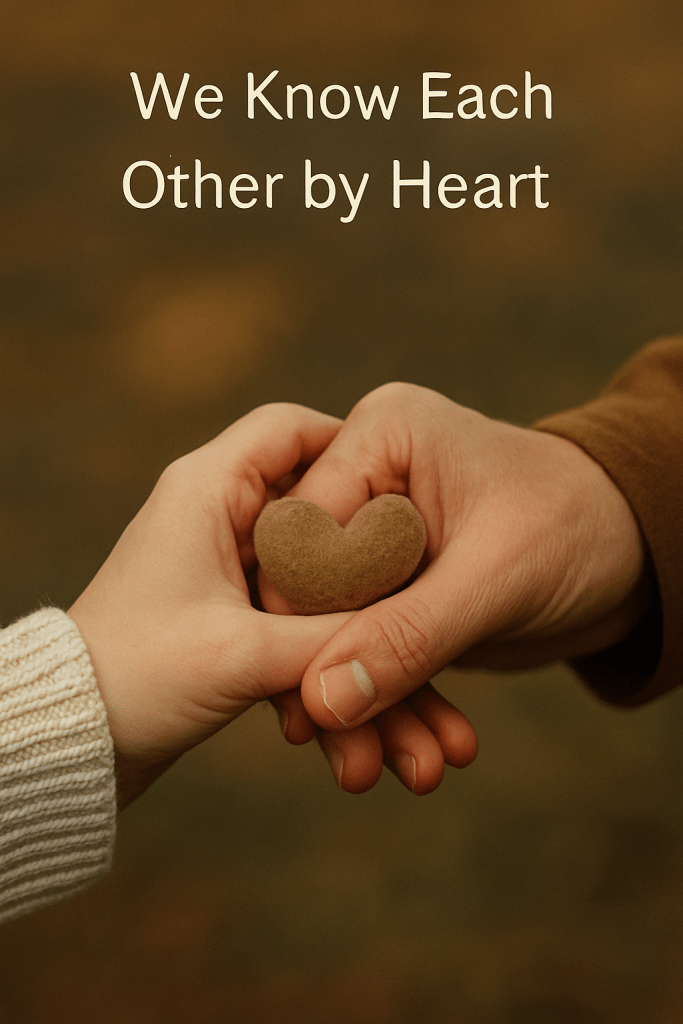
Even now — even in the forgetting — he still reaches for my hand.
Sometimes he asks, “Where are we?” even though we’re already home. So I take his hand and gently say, “We’re almost there. We’re safe.” And in that moment, I see it — the soft relief in his eyes, the quiet contentment that comes just from feeling me close.
When I whisper “I love you,” or bounce up to kiss him unexpectedly, he smiles — that same familiar smile.
Sometimes, he doesn’t recognise my face. Sometimes, he forgets my name. But then he’ll look at me and say, “You’re the best one… the one who’s always been good to me.”
And that’s when I know — even when memory slips away, his heart still remembers who I am.
Because even when words fade… love stays.
They say dementia takes things away. And it does.
But what it gives — oddly, painfully — is clarity. You start to see what truly matters.
The way someone’s hand fits yours. The weight of a smile. The way love — real love — doesn’t disappear. It simply learns to speak in softer ways.
And me
I’ve learned to let go of the version of him that lived in full colour
but I’ve never let go of the man.
Because I still see him. In glimpses. In gestures. In love.
We knew each other by heart. And somehow… through it all…
we still do.
Not just in memory, but in rhythm. In the way his hand still finds mine. In the way my voice still steadies him.
In the way we sit in silence now — no words needed — and still feel whole.
Because love — our love — hasn’t faded with the forgetting. It has only softened, deepened, endured.
It lives in the way we reach for each other, even when the past slips away.
And that is the truth we carry between us. Always.
Even now.
Especially now.

Leave a comment